
How To Build And Play My Little Pony MTG Decks
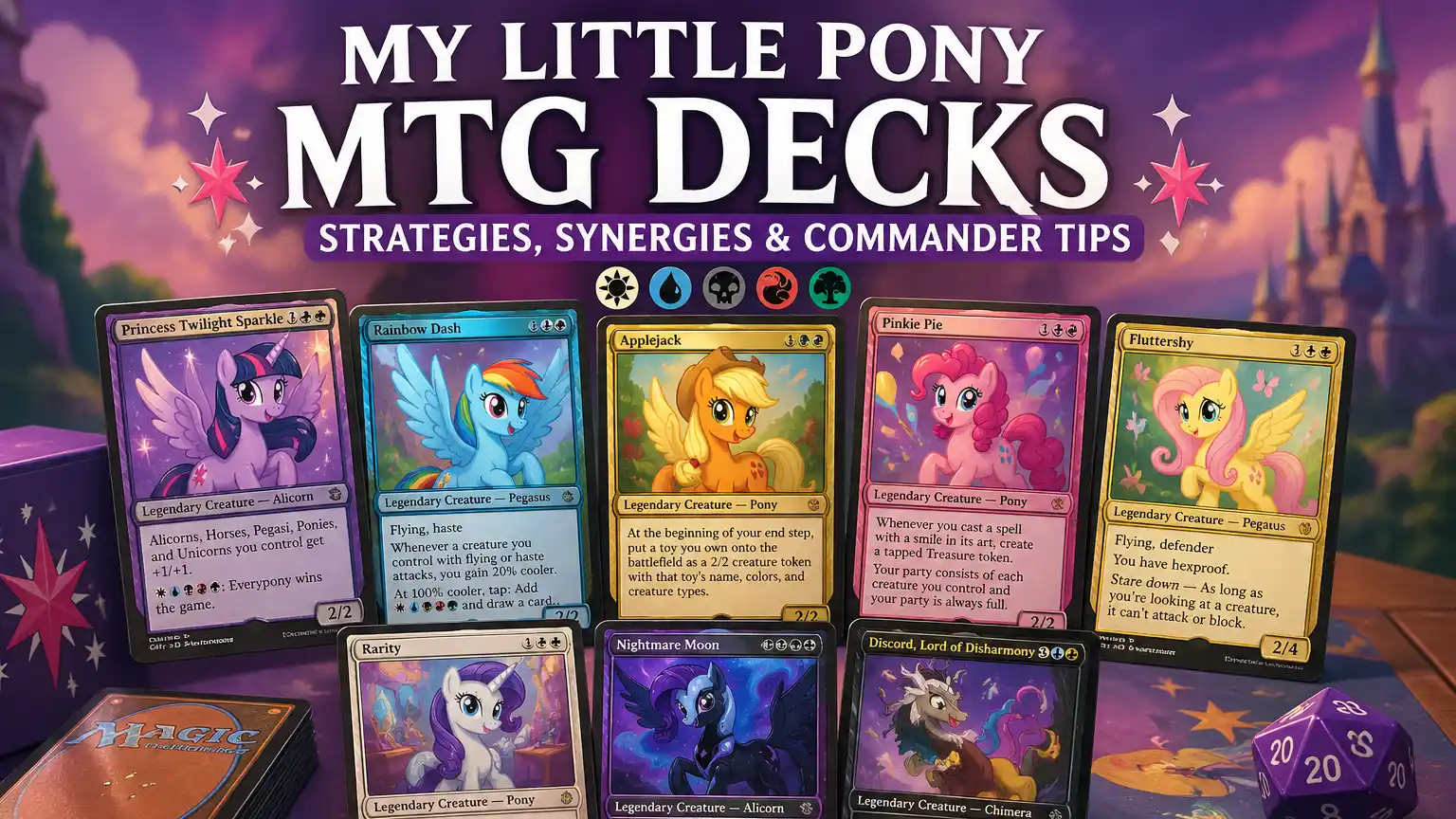
Table of Contents
TLDR
My Little Pony MTG decks work best when you lean into the joke but still build a real Commander shell. Princess Twilight Sparkle wants five-color setup and protection. Rainbow Dash wants fast flyers and haste creatures. Applejack, Fluttershy, Pinkie Pie, Rarity, Nightmare Moon, and Discord are better when you treat them as engines, support pieces, or political cards instead of trying to make every card equally central.
Introduction
“Friendship wins the game” sounds like a joke until you realize Princess Twilight Sparkle is an actual alternate win condition. And honestly, that is the whole appeal of My Little Pony MTG decks. They are silly, flavorful, and way more interesting than they have any right to be.
The trick is not to build a deck that only says, “Look, ponies.” That wears off by turn four. The better plan is to build a real casual Commander deck with a Pony-shaped finish. Use the My Little Pony cards as the identity of the deck, then surround them with ramp, protection, token support, flyers, and enough card draw to keep the game moving.
The original Ponies: The Galloping release included three silver-bordered cards, while Ponies: The Galloping 2 added Applejack, Fluttershy, Pinkie Pie, and Rainbow Dash as mechanically unique cards tied to Extra Life. Wizards described the 2023 drop as a way to complete the Mane Six collection that started with the 2019 release.
Start With The Pony You Actually Want To Build Around
The first decision is simple: are you building a Princess Twilight Sparkle deck, a Rainbow Dash deck, or a “play all the Ponies because we can” deck?
Those are not the same thing.
Princess Twilight Sparkle is the cleanest commander-style centerpiece because she gives a creature-type buff and has the famous five-color “everypony wins the game” ability. Rainbow Dash is much more aggressive. She rewards you for attacking with flying and haste creatures, then turns coolness into five-color mana and a card. Pinkie Pie, Applejack, Fluttershy, Rarity, Nightmare Moon, and Discord all have strong deckbuilding hooks, but most of them are better as support cards than as the whole plan.
Before you sleeve anything up, I’d sketch the shell in the MTG deck builder on mtg.cards. Pony decks have awkward color needs, specific creature requirements, and a lot of “maybe this is hilarious” cards that should probably start in the maybe-board. The mtg.cards builder supports Commander setup, deck stats, card search, and a maybe-board area, which is useful for sorting the fun cards from the cards that actually help the deck function.
Princess Twilight Sparkle: Build Toward The Group Win
Princess Twilight Sparkle is the obvious face of My Little Pony MTG decks because she gives you a real goal: control Applejack, Fluttershy, Pinkie Pie, Rainbow Dash, and Rarity, then activate Twilight’s five-color ability so everypony wins.
That sounds easy until you remember you need six specific creatures on the battlefield, five colors of mana, and a table that does not immediately remove Twilight out of fear, spite, or comedy.
So build Twilight like a five-color creature-combo deck with a friendly mask.
Your main priorities are ramp, fixing, tutors, protection, and recursion. You want green ramp to find your colors, blue and white protection to keep the board intact, and enough search effects to assemble the Mane Six without waiting forever. Cards like Heroic Intervention, Teferi’s Protection, Flawless Maneuver, and Eerie Interlude fit the spirit of the deck because your actual win condition requires your board to stay alive.
The biggest mistake is going too hard on random Horse, Unicorn, Pegasus, and Pony creatures just because Twilight buffs them. A small creature-type package is fine, but the alternate win condition is the real story. If a creature does not help you find Ponies, protect Ponies, ramp into Ponies, or buy time, it needs to be pretty good on its own.
Rainbow Dash: Play Flyers, Haste, And Extra Combat
Rainbow Dash is the most “normal Magic card” of the bunch. She has flying and haste, and whenever a creature you control with flying and/or haste attacks, you get 20% cooler. Once you are at least 100% cool, her Sonic Rainboom ability taps for WUBRG, draws a card, and resets your coolness.
That gives you a very clear plan: attack with five qualifying creatures.
You do not need to get fancy. Play cheap flyers. Play haste creatures. Make tokens with flying. Use cards that give your whole team haste. Then turn Rainbow Dash into a burst-mana engine.
Good shells include Boros flyers, Jeskai tempo, or five-color “Dash unlocks the splash” builds. The more competitive-looking version uses extra combat steps, because each combat gives you another chance to gain coolness. The fun version just plays every efficient evasive creature you can justify and starts turning sideways.
Rainbow Dash also plays well as part of the Twilight deck. She helps make five-color mana, attacks naturally, and gives the deck a second engine when you have not found every member of the Mane Six yet.
Applejack: Treat Toys Like Token Engines
Applejack is the card that most clearly reminds everyone that you are not playing normal Commander anymore. At the beginning of your end step, she lets you put a toy you own onto the battlefield as a 2/2 creature token with that toy’s name, colors, and creature types. If the toy has wings, it gets flying. If it has a horn, you scry 2. If it has neither, you make a Food token.
That is absurd. It is also a real engine.
The clean way to build around Applejack is token support. Think populate, anthem effects, lifegain payoffs, and sacrifice outlets if your table is comfortable with the toy-token nonsense. Applejack gives you bodies every turn, and bodies are one of the easiest resources to convert into damage, cards, mana, or value.
Just keep the toy situation readable. Don’t show up with a shoebox full of objects and expect the game to move quickly. Bring a few clear options, explain what they do, and keep the board state sane. The fun part is the bit. The annoying part is making everyone inspect a plastic dragon for a subtype ruling.
Fluttershy: Use The Stare As Soft Removal
Fluttershy is not here to race anyone. She is a defensive support piece with flying, defender, counters for creatures with tails, and the “stare down” mechanic. The stared-down creature cannot attack or block as long as you are looking directly at it.
That makes Fluttershy a table-management card.
Use her to stop the scariest attacker, protect a player who is behind, or keep a huge commander from connecting. She gets better when you can untap her repeatedly or protect her from incidental removal. Seedborn Muse-style play patterns are very funny here because Fluttershy can keep updating the table’s biggest problem.
In Twilight decks, Fluttershy is mostly one of the required pieces. But she still has a job. She buys time, blocks flyers, and gives you a political tool that does not feel as hostile as outright removal.
Pinkie Pie: Build Around Party And Smiling Art
Pinkie Pie rewards you whenever you cast a spell with a smile in its art by making a tapped Treasure token. She also says your party consists of each creature you control and your party is always full.
The smile clause is the kind of thing you either love immediately or want nowhere near your table. The party clause is easier to use in normal deckbuilding.
Cards that care about having a full party become much more reliable with Pinkie Pie. The problem is that many party cards were balanced around requiring Cleric, Rogue, Warrior, and Wizard setup. Pinkie skips that work. So you can run payoff cards without loading your deck with mediocre party creatures.
The Treasure ability is more of a bonus unless you are willing to curate art. That can be fun, but it is also a rabbit hole. My advice: do not build the whole deck around identifying smiles unless your group enjoys that kind of thing. Use it as seasoning.
Rarity: Make Rare Spells Cheaper And Protect Key Creatures
Rarity reduces the cost of rare and mythic rare spells you cast by one generic mana. She can also reveal a My Little Pony toy you own to give another target creature protection from colors shown on that toy’s coat, mane, and outfit.
That first ability is better than it looks.
Commander decks are full of rares and mythics. Rarity can discount a surprising amount of your deck without asking you to build around her very hard. That makes her a nice value piece in Twilight, but she can also support a higher-rarity good-stuff shell if you want the deck to play smoother.
Her protection ability is the bigger flavor win. Use it to force through damage, protect Twilight, or save a key Pony from removal. It is not always clean, because toy colors can become a whole table discussion, but when it works, it feels exactly like the card should.
Nightmare Moon And Princess Luna: Make It Political
Nightmare Moon transforms into Princess Luna when six mana is paid, and anypony can help pay that cost. Players who help become your friends. When Princess Luna transforms, she can exile up to six cards you own from outside the game with a moon in their art, and you and your friends may cast them with permission.
This is not a normal Magic card. Do not try to make it one.
The best Luna decks are political toolbox decks. You are not just asking, “What is the strongest moon-art card?” You are asking, “What cards create the best table story?” Removal with moon art, Blood Moon-style effects, and splashy spells all work, but the social contract matters more than raw power.
Use Luna when your group likes negotiation. Offer a friend access to a spell if they help transform Nightmare Moon. Make deals. Let the card create a mini-game. That is the point.
Discord: Embrace Chaos, But Keep The Deck Stable
Discord, Lord of Disharmony is a 3/5 flying Chimera that chooses a random nonland Magic card name at your end step. Until your next end step, you may cast a copy of a spell with that name, and mana of any type can be spent to cast it. If you cast a spell this way, Discord copies the ability if he is still on the battlefield.
This card is chaos in a top hat.
The deckbuilding lesson is simple: if your commander or engine is random, the rest of the deck should not be. Play ramp. Play removal. Play card draw. Play ways to protect Discord. Then let the random spell name be the memorable part.
Do not overload the deck with other chaos cards unless your table loves long, confusing turns. One Discord is funny. Twelve Discord-adjacent effects can turn the game into paperwork.
Best Strategy By Play Style
| Play Style | Best Pony Focus | What The Deck Wants |
|---|---|---|
| Alternate Win | Princess Twilight Sparkle | Tutors, fixing, protection, recursion |
| Aggro | Rainbow Dash | Flyers, haste, extra combat, token pressure |
| Tokens | Applejack | Anthems, populate, sacrifice outlets, lifegain |
| Control / Politics | Fluttershy or Luna | Pillow fort, soft removal, table deals |
| Value | Rarity | Rare-heavy spells, protection, efficient creatures |
| Chaos | Discord | Stable shell, flexible mana, protective cards |
The best overall deck is probably Princess Twilight Sparkle with Rainbow Dash as a backup engine. It gives you the most complete Pony experience while still leaving room for real Magic cards that make the deck function.
The most playable single-card strategy is Rainbow Dash aggro. It asks the least from your table, closes games naturally, and turns the Pony joke into a real combat plan.
The funniest deck is probably Nightmare Moon or Discord. Not the cleanest. Not the fastest. But if your goal is to tell a story that your pod will still remember next week, those are hard to beat.
Common Mistakes To Avoid
Do not make every card a flavor pick. You still need lands, ramp, draw, interaction, and a plan for rebuilding after a board wipe.
Do not forget protection. Pony decks attract attention because everyone wants to see what happens, but they also attract removal because the alternate win condition is loud.
Do not make the table solve unclear physical-object rules every turn. Applejack, Rarity, and Fluttershy are funnier when everyone understands what is happening.
And do not assume the game has to end with Twilight. Sometimes Rainbow Dash beats down. Sometimes Applejack makes a board. Sometimes Discord casts something ridiculous. Let the deck win sideways.
FAQs
Are My Little Pony MTG Decks Good?
They can be good in casual Commander, but they are more about fun, flavor, and table stories than raw efficiency. Rainbow Dash is the cleanest aggressive engine, while Princess Twilight Sparkle gives the deck its most iconic win condition.
What Is The Best Commander For A My Little Pony MTG Deck?
Princess Twilight Sparkle is the best choice if you want the full Mane Six experience. Rainbow Dash is better if you want a smoother combat deck with less setup.
How Do You Win With Princess Twilight Sparkle?
You need to control Applejack, Fluttershy, Pinkie Pie, Rainbow Dash, and Rarity, then activate Twilight’s WUBRG ability. The practical plan is to ramp, tutor for missing Ponies, protect your board, and activate only when you are ready.
Is Rainbow Dash Actually Strong?
Rainbow Dash is stronger than the joke suggests. A deck full of flyers, haste creatures, and extra combat effects can reach 100% coolness quickly, then use Sonic Rainboom for mana and card draw.
Should I Build Around Every Pony Equally?
No. Pick one main plan and let the other Ponies support it. Twilight wants assembly and protection. Rainbow Dash wants combat. Applejack wants tokens. Trying to make every Pony the star usually makes the deck less focused.
Conclusion
My Little Pony MTG decks are at their best when they are built like real decks with a ridiculous finish. That means you still need boring things like mana fixing, removal, card draw, and protection. The Ponies supply the personality. The rest of the deck makes sure the personality survives long enough to matter.
For most players, I’d start with Princess Twilight Sparkle as the main deck and Rainbow Dash as the backup plan. That gives you the “everypony wins” dream while still letting you attack, draw cards, and generate mana when the full combo is not happening.
And if your group is more into chaos than clean wins, play Discord or Nightmare Moon. Just be ready for the game to become less about optimal lines and more about asking, “Wait, does that moon count?”