
Do MTG Tokens Go to the Graveyard? Dies Triggers Explained
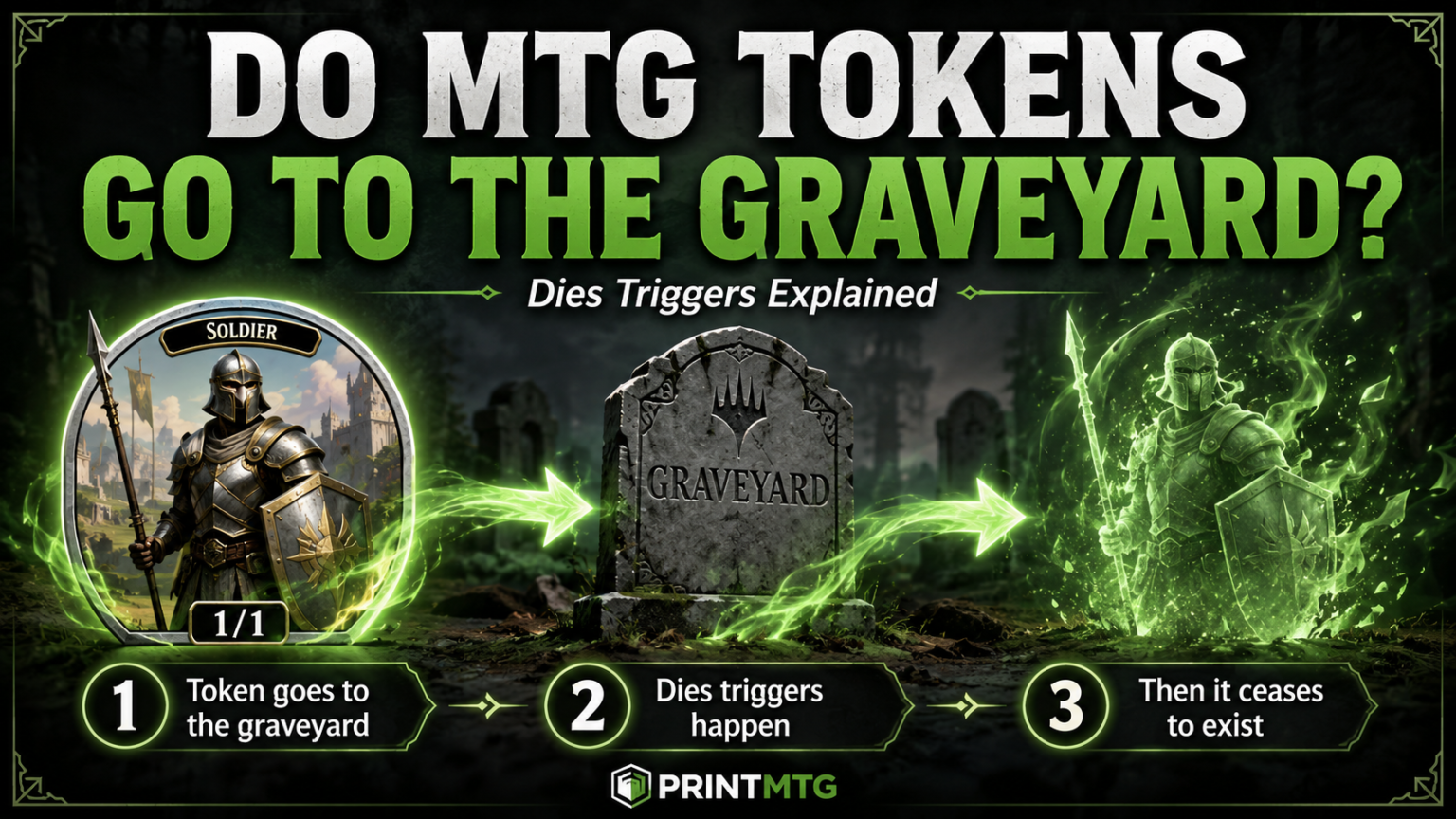
Table of Contents
TLDR
Yes, MTG tokens do go to the graveyard if an effect, sacrifice, lethal damage, or other game action sends them there. They enter the graveyard first, so applicable dies and leaves-the-battlefield abilities can trigger. Then, the next time state-based actions are checked, the token ceases to exist.
That brief stop in the graveyard matters quite a lot. Magic tokens have enough time to die, trigger several abilities, cause everyone to point at Blood Artist, and then disappear before anybody can reanimate them. Efficient little things.
If you have ever wondered do MTG tokens go to the graveyard, the confusing part is usually not whether they get there. They do.
The confusing part is what happens next.
A token does not simply vanish the instant it leaves the battlefield. Magic actually moves the token to the appropriate zone first. If that zone is the graveyard, the token was put into a graveyard from the battlefield, which means a creature token has died.
Only afterward does the game clean it up.
Do MTG Tokens Go to the Graveyard Before They Disappear?
Yes.
The Magic Comprehensive Rules specifically say that a token in a zone other than the battlefield ceases to exist as a state-based action.
But the rule immediately adds an important clarification: if a token changes zones, applicable triggered abilities trigger before the token ceases to exist.
So imagine your 1/1 Soldier creature token takes lethal damage.
The Soldier is put into the graveyard.
Any applicable abilities see that event.
State-based actions are checked.
The Soldier token ceases to exist.
The important part is that the game does not retroactively pretend the token never entered the graveyard. It got there. It just had an extremely short lease.
Do Token Creatures Trigger “Dies” Abilities?
Yes.
Magic defines “dies” as being put into a graveyard from the battlefield.
A creature token that moves directly from the battlefield to a graveyard satisfies that definition exactly.
That means creature tokens can trigger cards such as Blood Artist, Zulaport Cutthroat, Grave Pact, and other effects that care about creatures dying.
Suppose you control five creature tokens and all five are destroyed by a board wipe.
All five go from the battlefield to the graveyard.
All five die.
An ability that triggers whenever another creature dies can therefore trigger for each qualifying token.
The tokens will cease to exist shortly afterward, but the triggered abilities do not disappear with them. The game already saw the deaths.
This is one of the basic engines behind sacrifice and “Aristocrats” decks. Tokens are cheap bodies that can be converted into damage, cards, mana, or other effects precisely because token deaths count.
What Exactly Happens When an MTG Token Dies?
The clean mental model is:
Battlefield → graveyard → dies triggers happen → token ceases to exist.
Technically, triggered abilities trigger when the relevant event occurs, then state-based actions are checked before those triggered abilities are put onto the stack and players receive priority.
You do not normally need to narrate that entire process at the table unless someone has started opening the Comprehensive Rules on their phone, which usually means casual game night has entered its appellate phase.
The useful takeaway is simpler.
The token reaches the graveyard.
Anything that appropriately cares about that zone change can notice.
Then the token disappears.
Does Sacrificing a Token Count as Dying?
If it is a creature token, yes.
Sacrificing a permanent moves it from the battlefield to its owner’s graveyard. So when you sacrifice a creature token, it moves from the battlefield to the graveyard and therefore dies.
This is the same interaction discussed in our guide to sacrificing creatures in MTG.
There is one important distinction, though.
Not every token is a creature.
A normal Treasure token is an artifact token. Sacrificing that Treasure puts it into the graveyard before it ceases to exist, but it does not count as a creature dying because it was not a creature.
If some effect has turned the Treasure into an artifact creature, now things are different. Magic is very fond of making simple rules wait quietly until another card arrives with a crowbar.
Can a Token Trigger Its Own Dies Ability?
Yes.
If a creature token itself has an ability that triggers when it dies, that ability can trigger as the token moves into the graveyard.
The token does not need to remain in the graveyard for the triggered ability to work.
Magic can use information about what the permanent looked like immediately before it left the battlefield when determining many leaves-the-battlefield triggers.
So a creature token with its own death ability can die, trigger that ability, cease to exist, and still have its triggered ability waiting to resolve.
The source may be gone. The paperwork continues.
Can You Reanimate a Token From the Graveyard?
No.
This is where the “tokens go to the graveyard” answer stops behaving like normal creature cards.
The Comprehensive Rules say two relevant things.
First, a token in a zone other than the battlefield ceases to exist.
Second, a token that has left the battlefield cannot move to another zone or return to the battlefield.
So you cannot let a creature token die and then cast a reanimation spell to bring it back.
By the time you could normally act, the token has ceased to exist anyway. And even before that cleanup, the rules prevent a token that has left the battlefield from moving again.
There is another distinction here: a token is not a card.
An effect looking specifically for a “creature card” in your graveyard cannot select a creature token. Printing a lovely full-size token card does not change this. The game remains stubbornly uninterested in your production values.
What If a Token Goes to Exile Instead?
Then it did not die.
“Dies” requires an object to move from the battlefield to the graveyard.
If a replacement effect changes that event so the token is exiled instead, the token never reaches the graveyard. Therefore, abilities that require a creature to die do not trigger from that event.
The token will still cease to exist after leaving the battlefield, but it took the exile route rather than the graveyard route.
That distinction matters in decks where effects replace graveyard movement with exile.
The destination is not flavor text. It determines which triggers happen.
What Happens If You Bounce a Token to Its Owner’s Hand?
The token can move from the battlefield to the hand.
Then it ceases to exist.
It did not die because it never went to the graveyard.
And you cannot cast it from the hand because, shortly after arriving, there is no token left to cast.
This is why returning an opponent’s expensive creature token to their hand is usually functionally permanent removal. You have not destroyed it, but the result for that token is still rather final.
Can You Blink a Token?
Not successfully in the normal sense.
Blink effects usually exile a permanent and then return it to the battlefield, either immediately or later.
A token can be exiled, but once it has left the battlefield, the rules say that token cannot return to the battlefield or move to another zone.
So a blink effect can remove a token, but it will not bring that same token back.
This can catch players who are accustomed to blinking ordinary creature cards for value. Cards come back. Tokens discover that the return ticket was apparently nonrefundable.
Do Token Copies Go to the Graveyard?
Yes.
A token that is a copy of another permanent is still a token.
If you create a token copy of a creature and that copy is later destroyed, sacrificed, or killed by lethal damage, it goes to the graveyard and dies just like any other creature token.
Then it ceases to exist.
Copying an expensive legendary creature onto a token does not give the token special graveyard privileges. It remains a token despite having the name, abilities, power, toughness, and other copied characteristics of the original.
What About Role Tokens, Clues, Food, and Treasures?
The same core rule applies to all tokens.
A token can move from the battlefield to another zone and will then cease to exist.
What changes is which abilities care about the event.
A creature token can die.
A Treasure token being sacrificed is an artifact going to the graveyard, not normally a creature dying.
A Role token is an Aura enchantment token. When it goes to the graveyard, it will cease to exist there as well. If you want the separate rules peculiar to Roles, we have a full guide to Role tokens in MTG.
Always ask what the token actually is before deciding which triggers care about it.
“Creature Dies” vs. “Creature Card Goes to the Graveyard”
This wording difference is easy to miss.
An ability that cares about a creature dying can see a creature token die.
An effect that specifically refers to a creature card in a graveyard cannot treat the token as a creature card, because tokens are not cards.
That single word, “card,” matters.
Magic rules questions frequently come down to one extremely ordinary-looking word doing far more work than anybody expected. This is why reading the exact text usually beats remembering what the card “basically does.”
Why This Matters in Token-Heavy Decks
Token strategies often depend on more than attacking with a large number of creatures.
Sacrifice decks convert tokens into death triggers. Commander decks may use tokens to feed sacrifice outlets. Treasure decks sometimes turn artifacts into creatures. Copy strategies create token versions of creatures with valuable leaves-the-battlefield abilities.
If you are testing one of those decks, having the correct tokens on the table makes state tracking much easier. A Zombie, Treasure, Role, Clue, and token copy may all be represented by rectangles, but the rules care rather deeply about the difference.
And once ten or fifteen tokens are involved, a handwritten scrap reading “guy 3/3 maybe flying” stops being charming.
FAQs
Do MTG Tokens Go to the Graveyard When They Die?
Yes. A creature token that dies moves from the battlefield to the graveyard. Applicable triggered abilities can trigger, then the token ceases to exist as a state-based action.
Do Tokens Trigger Blood Artist?
Creature tokens do. When a creature token goes from the battlefield to the graveyard, it dies, so Blood Artist can trigger from that death.
Can You Bring a Token Back From the Graveyard?
No. A token that has left the battlefield cannot move to another zone or return to the battlefield, and a token outside the battlefield will cease to exist.
Does Sacrificing a Treasure Count as a Creature Dying?
Normally, no. A Treasure is an artifact token, not a creature. If another effect has turned that Treasure into a creature, then sacrificing it can count as a creature dying.
Does Exiling a Creature Token Trigger Dies Abilities?
No. A creature dies only if it moves from the battlefield to the graveyard. Moving from the battlefield to exile is a different zone change.
Do Token Copies Trigger Dies Abilities?
Yes, if the copied token is a creature and it goes from the battlefield to the graveyard. Being a copy does not change the fact that it is a token.