
MTG Premodern Proxies: Build a Casual Premodern Gauntlet
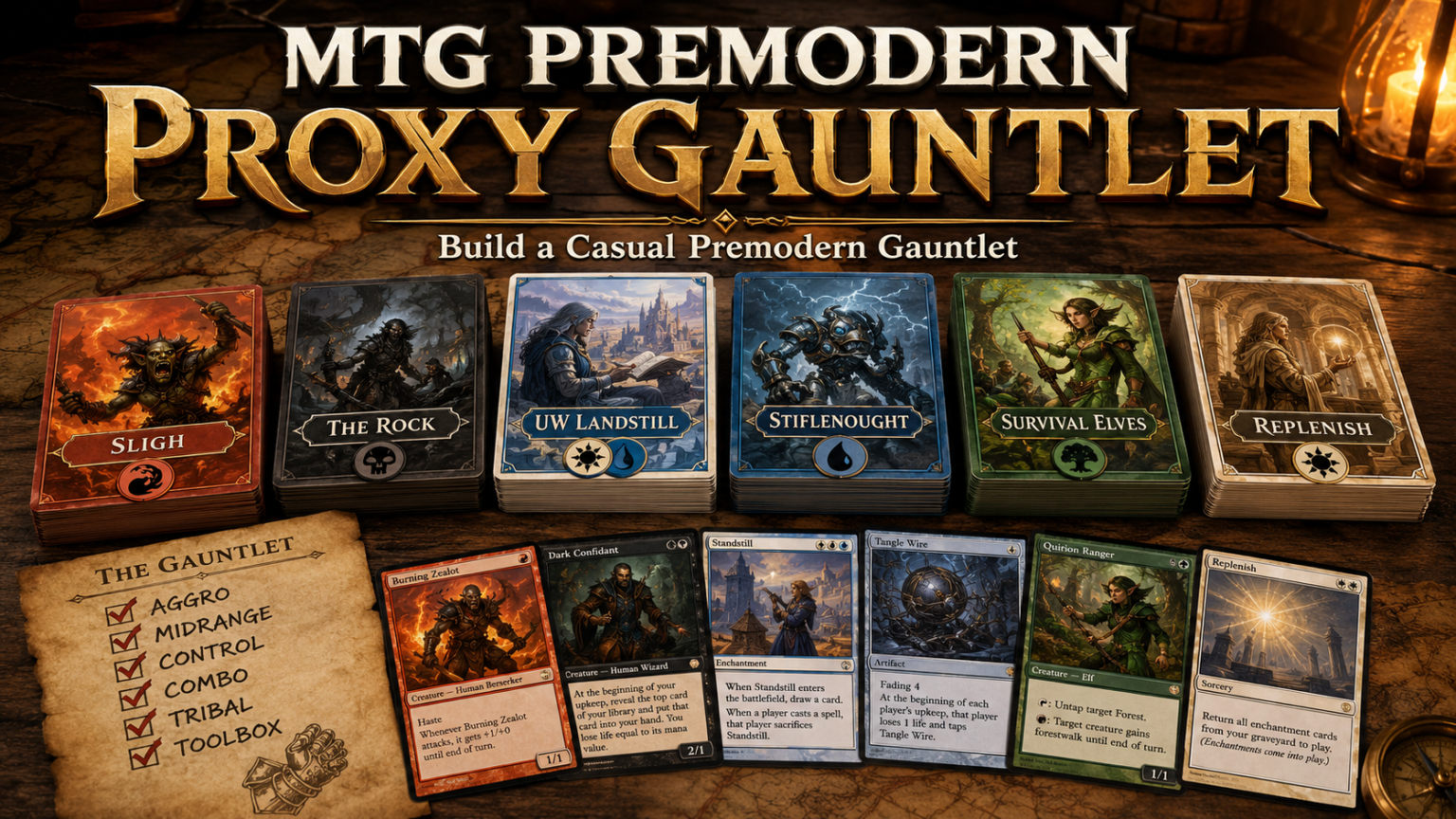
Table of Contents
TLDR
Premodern proxies are an excellent way to build a reusable box of classic Magic decks without assembling six separate collections of increasingly elderly cardboard. Start with four decks that represent different strategies, then expand to six if your group likes the format.
For a strong starter gauntlet, I like Sligh, The Rock, UW Landstill, and Stiflenought. Add Survival Elves and a dedicated combo deck such as Replenish or Frantic Returns when you want a broader spread of matchups.
Premodern is one of those Magic formats that sounds like nostalgia until you actually play it. Then a Jackal Pup attacks you, someone casts Fact or Fiction, Phyrexian Dreadnought appears for suspiciously little mana, and suddenly it is 2001 again except your knees hurt.
That makes Premodern proxies particularly useful. Instead of building one deck, a proxy gauntlet lets you build a miniature version of the format: several complete decks that can be shuffled up, swapped around, tested against one another, and left ready for the next game night.
And unlike a random pile of old cards, a good gauntlet has a purpose.
What Is a Premodern MTG Gauntlet?
A gauntlet is a collection of complete decks chosen to represent different strategies and matchups.
Rather than saying, “I have a Premodern deck,” you can say, “Pick a box.”
That changes the experience considerably. Someone who has never played Premodern can sit down, grab Sligh, and understand the general plan within about thirty seconds. Another player can take UW Landstill and spend the next hour demonstrating that drawing cards and saying “no” remains a viable personality.
Premodern itself is a community-created constructed format built around sets from Fourth Edition through Scourge. The official format site describes the rough card pool as old-frame cards printed from 1995 through 2003 that were Standard legal during that period, with a specific legal-set list and its own banned list.
Importantly, Premodern uses contemporary Magic rules. You get the old cards without having to remember which version of combat damage rules was causing arguments in the parking lot in 1999.
The format also has a surprisingly broad strategic range. Aggro, control, combo, midrange, tribal decks, graveyard strategies, prison shells, and enormous one-mana artifacts all have homes.
That diversity is exactly why a Premodern proxy gauntlet works so well.
Why Premodern Proxies Make Sense for a Gauntlet
Proxying one deck saves you from committing to cards before you know whether you enjoy the deck.
Proxying a gauntlet solves a different problem: duplication.
Premodern decks often share desirable lands and staples. Wasteland, fetch lands, Mox Diamond, City of Brass, Rishadan Port, and other cards can appear across multiple strategies. Building six paper decks simultaneously means either constantly moving cards between decks or acquiring several copies of staples.
Moving cards between decks is technically free. It is also how you eventually spend twenty minutes looking for the Wastelands that are apparently “definitely in one of these deck boxes.”
Premodern proxies let every deck stay complete.
That makes the gauntlet something you actually use instead of a complicated storage system for partially assembled decks.
If you have not built a testing setup before, our guide to using MTG proxy cards to test a deck covers the basic playtesting approach. The same principle scales nicely from one deck to six.
Start With Four Premodern Decks
Do not begin by printing fifteen decks because you found fifteen lists.
You can. Magic players are rarely stopped by reasonable advice.
But a four-deck gauntlet is enough to experience the format and learn which matchups you actually enjoy.
Deck 1: Sligh
Sligh is where I would start.
The deck gives your gauntlet a fast, aggressive baseline. Classic versions use creatures such as Jackal Pup, Mogg Fanatic, and Grim Lavamancer alongside Lightning Bolt, Incinerate, Fireblast, Cursed Scroll, and other extremely red ways of expressing disagreement.
Sligh also remains relevant rather than merely historic. A Sligh list won the inaugural Singapore Premodern Nationals in June 2026.
That makes it perfect gauntlet material.
If another deck cannot stabilize against Sligh, you learn quickly. If the control player keeps a hand that does nothing until turn four, Sligh provides a brief educational seminar.
Deck 2: The Rock
Next, add a midrange deck.
The Rock is one of Premodern’s classic representatives. Its game plan is less explosive than Sligh and less controlling than Landstill. Instead, it combines efficient threats, removal, disruption, and grinding card advantage.
That gives the gauntlet something important: a deck that makes both players play normal Magic.
Normal is relative here.
This is still a format where Pernicious Deed exists.
The Rock is useful for testing because it pressures combo without simply racing it, interacts with creatures without becoming a dedicated control deck, and asks whether slower strategies can survive repeated one-for-one exchanges.
Deck 3: UW Landstill
Now somebody needs to be the villain.
UW Landstill gives the box a traditional control strategy built around countermagic, removal, board control, manlands, Standstill, and cards such as Fact or Fiction.
Its job in the gauntlet is not merely to make games longer. Although it will bravely attempt that.
Landstill tests whether the other decks can generate threats without overextending, fight through permission, and create meaningful pressure against a deck designed to reach the late game.
It also feels unmistakably like Magic from the Premodern era. Counterspell really does cost UU. Fact or Fiction really does make everyone at the table lean forward. Mishra’s Factory keeps quietly doing work despite looking like something excavated from an ancient binder.
Deck 4: Stiflenought
For the fourth deck, add something unfair.
Stiflenought uses Stifle or Vision Charm to circumvent Phyrexian Dreadnought’s enormous downside and put a 12/12 trampler onto the battlefield for very little mana.
It is part combo deck, part tempo deck, and part lesson in why Magic players immediately become suspicious when a one-mana creature has twelve power.
Stiflenought has remained prominent in modern Premodern play. The format’s January 2026 ban discussion specifically noted that Stiflenought had become particularly frequent in Magic Online Premodern play.
That gives the starter box four very different questions:
- Can you survive Sligh?
- Can you grind through The Rock?
- Can you break through Landstill?
- Can you stop Stiflenought before twelve points of trampling nostalgia lands on your face?
That is already a real gauntlet.
Expand the Premodern Proxy Gauntlet to Six Decks
Once everyone starts developing favorites, six decks is the sweet spot I prefer.
Add Survival Elves as the fifth deck.
Survival Elves combines creature-heavy play with Survival of the Fittest and a toolbox-style engine. It can develop a large board, generate card selection, and pivot between aggression and more synergistic lines. The archetype is not some museum piece either. Survival Elves won the 189-player Italian Premodern Nationals in February 2026.
For the sixth deck, add a more dedicated combo strategy.
Replenish is the classic choice if you want an iconic Premodern experience. Another option is a storm-oriented shell such as Frantic Returns, a combo deck highlighted by the Premodern site in July 2026 that combines the Frantic Storm shell with Lion’s Eye Diamond and Diminishing Returns.
Dedicated combo adds a completely different axis. Suddenly the Sligh player has to decide how aggressively to race, the control player needs to preserve the right interaction, and the midrange player discovers that casting a solid three-drop is not always the answer to life’s problems.
Six decks is enough variety that the box stops feeling like four fixed matchups and starts feeling like a small format.
Check the Current Ban List Before Printing Older Lists
This matters with Premodern because plenty of excellent decklists online are historical.
The most important recent example is Parallax Tide, which was banned in January 2026.
Older Tide Control, Replenish, and Stiflenought lists may contain it. Those lists can still be useful starting points, but do not blindly print a deck from three years ago and assume nothing has happened since.
The official Premodern site maintains the current legal sets, banned cards, deck gallery, and recent tournament reports.
For a proxy gauntlet, I would pull relatively current 75-card lists whenever possible, then save the exact versions you printed. That way your gauntlet has a known baseline rather than six decks that mysteriously mutate every time somebody finds a new deck tech.
Print the Sideboards Too
A gauntlet gets much better when each deck includes its full sideboard.
Game one teaches you what the decks naturally do.
Games two and three teach you the matchup.
Premodern sideboards can substantially change how decks interact. Graveyard hate, artifact and enchantment removal, blasts, sweepers, combo disruption, and specialized hate cards all matter.
Without sideboards, you are testing only half the format.
If you are already printing 60 cards, printing another 15 is not where fiscal discipline suddenly needs to enter the conversation.
Keep the Physical Gauntlet Consistent
A reusable gauntlet should feel like one product rather than six separate craft projects.
Use the same sleeve type across every deck. Keep proxy thickness and finish reasonably consistent. Use readable card versions. Give every deck its own box and label it clearly.
This is similar to building a proxy Cube. Our guide to proxying an MTG Cube goes deeper into consistency, readability, sleeves, and maintaining one canonical list.
The important part is that players should be thinking about the game, not trying to decipher a borderless alternate-art version of Counterspell that looks like an album cover.
Premodern already contains enough old wording and unusual interactions. The physical cards do not need to add a side quest.
Should You Proxy Only the Expensive Cards?
For a single deck, sure.
For a gauntlet, I generally prefer complete proxy decks.
Mixing real cards and proxies works, but full decks give you consistent feel, consistent card backs, and much easier maintenance. You can also leave the decks assembled permanently.
That is the real advantage.
Your actual collection remains your collection. Your Premodern gauntlet becomes a self-contained game box.
Want to play The Rock tonight? Pick it up.
Want to hand Stiflenought to the person who said, “How bad could a 12/12 really be?” Go ahead. Education is important.
Good, Better, and Completely Unreasonable Premodern Gauntlets
A good gauntlet has four decks representing aggro, midrange, control, and combo or tempo-combo.
A better gauntlet has six decks and adds a creature-engine strategy plus a dedicated combo deck.
The completely unreasonable version has eight or more decks, multiple variants of major archetypes, tuned sideboards, labeled deck boxes, matchup notes, and probably its own shelf.
I am not discouraging the third option.
I am simply identifying the moment at which you have accidentally invented a second hobby.
FAQs
How Many Decks Should a Premodern Proxy Gauntlet Have?
Four is enough to start. Six gives you substantially more matchup variety without making the project unwieldy. I would build four first, play them, then choose the next two based on what your group wants more of.
What Are Good Starter Decks for a Premodern Gauntlet?
Sligh, The Rock, UW Landstill, and Stiflenought make a strong four-deck starting point. They represent aggressive, midrange, control, and tempo-combo strategies and produce very different games.
Should I Include Sideboards in a Premodern Proxy Gauntlet?
Yes. Premodern has meaningful post-sideboard games, and full 75-card decks let you actually learn matchups rather than endlessly replay game one.
What Sets Are Included in Premodern MTG?
Premodern uses a defined card pool from Fourth Edition through Scourge. The official Premodern site maintains the complete legal-set list and current banned list.
Does Premodern Use Old Magic Rules?
No. Premodern uses contemporary Magic: The Gathering rules. The card pool is old-school, but you do not need to resurrect an obsolete rules engine along with it.
Should Every Premodern Deck Be a Proxy?
For a permanent casual gauntlet, I think complete proxy decks are the cleanest option. They keep the decks assembled, make shared staples easy to manage, and give the whole box a consistent feel.