
TLDR
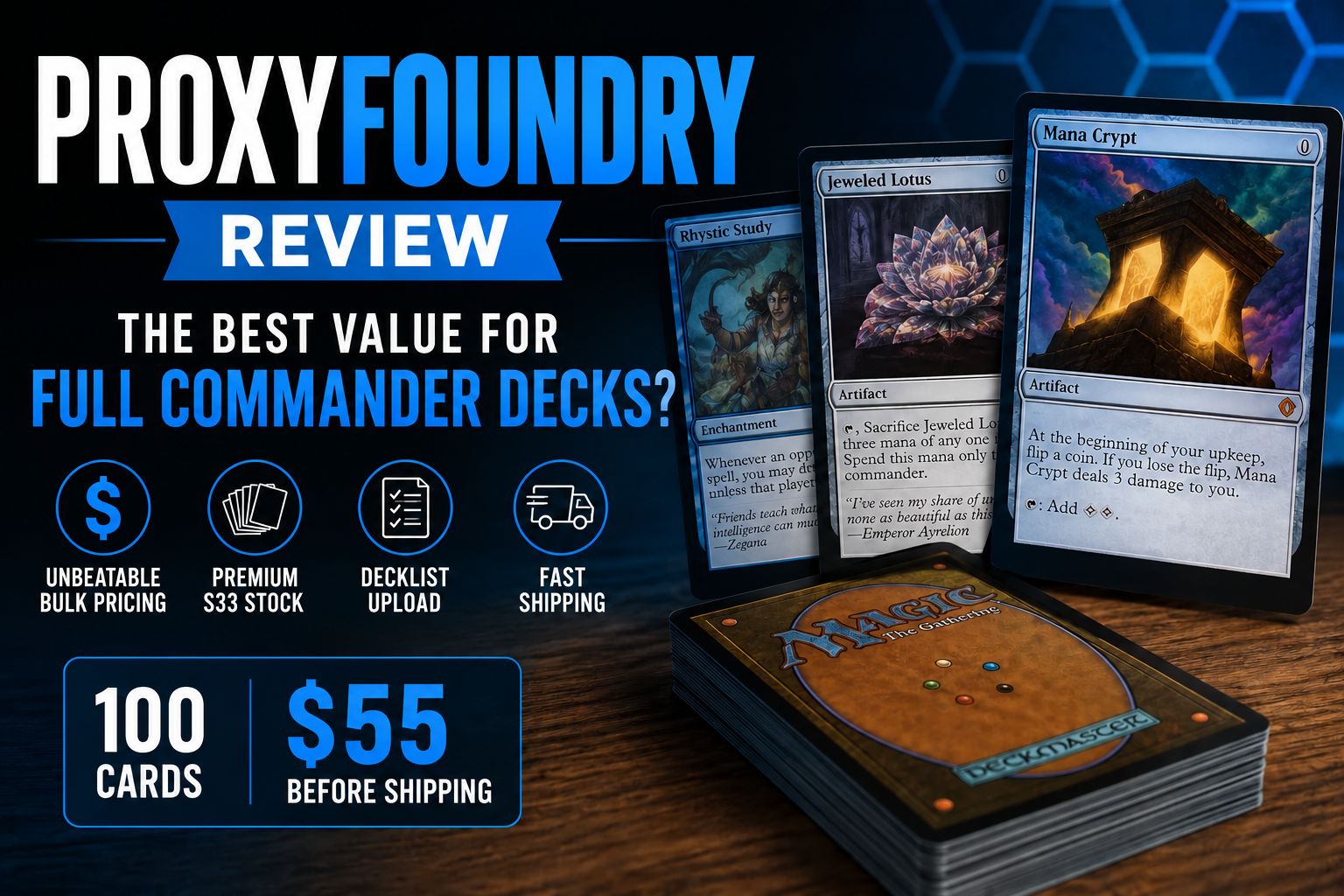
Our ProxyFoundry.com review comes down to one number: 100.
ProxyFoundry is merely okay value when you order a few cards, but its pricing gets dramatically better at 100 cards and continues dropping at 200, 500, and 1,000 cards. A 100-card Commander deck currently costs $55 before shipping, while sufficiently large orders can fall as low as $0.33 per card.
We think ProxyFoundry is one of the better choices for full Commander decks, playtest gauntlets, cubes, and large batches of staples. If you want a handful of unusually realistic premium singles, ProxyKing makes more sense. If you want distinctive custom artwork and a themed deck, Trinket Kingdom is playing a different game entirely. And if you want hundreds or thousands of cards at the lowest possible manufacturing cost and do not mind a more DIY workflow, MPC is still worth considering.
Overall rating: 4.5/5
A Quick Disclosure Before the Review
You are reading this on Trinket Kingdom, and Trinket Kingdom sells custom MTG proxies.
So yes, this is a proxy seller reviewing another proxy seller. Pretending otherwise would be a little silly.
Fortunately, ProxyFoundry and Trinket Kingdom are not really trying to solve the exact same problem. Trinket Kingdom focuses heavily on fully custom artwork, alternate visual themes, and cards you actually want people to stop and look at. ProxyFoundry is much more interesting as a practical printing service for someone who has a list and needs 100, 200, or 500 playable cards without spending $3 to $5 on every slot.
That distinction is what makes ProxyFoundry interesting.
ProxyFoundry.com Review Scorecard
| Category | Score | Our Take |
|---|---|---|
| Print Quality & Feel | 4.2/5 | Strong materials and generally good results, with some reports of color and corner variation |
| Bulk Pricing | 4.9/5 | Excellent once you reach 100 cards |
| Small-Order Value | 3.2/5 | Fine, but not a major reason to use the service |
| Selection & Ordering | 4.7/5 | Decklist upload, card search, versions, quantities, and bulk ordering are well handled |
| Customer Support & Policies | 4.0/5 | Much clearer policies than many proxy sites, though there are some mixed historical reports |
| Turnaround | 4.3/5 | Competitive for U.S. print-on-demand orders |
| Overall | 4.5/5 | One of our preferred options for full decks and bulk proxy orders |
These scores are our editorial assessment based on current product specifications, pricing, policies, ordering tools, and recent customer reports. We did not place a new anonymous test order specifically for this article.
What ProxyFoundry Actually Is
ProxyFoundry is a print-on-demand MTG proxy service.
Instead of browsing a small catalog of preprinted cards and adding everything one at a time, you can upload a decklist or search its card database, select versions, adjust quantities, and build an order around an actual deck.
That makes an enormous difference when the order contains 100 cards.
Adding 100 products individually is the kind of task that makes you question whether Commander was a mistake. A decklist-based workflow is much more sensible.
ProxyFoundry currently says there is no minimum order. You can print a single card, a handful of upgrades, a complete Commander deck, cube cards, or a much larger batch.
Its current production specifications include:
- S33 German black-core cardstock
- UV coating
- Precision die cutting
- Standard trading-card dimensions
- Print files enhanced to at least 300 DPI
- Multiple card versions where available
- Double-sided printing for selected double-faced cards
Those are serious specifications for cards meant to be shuffled and played rather than slipped into a sleeve in front of a basic land.
ProxyFoundry Print Quality: Good Enough to Build an Entire Deck Around
The material specification is probably the strongest part of ProxyFoundry's quality pitch.
S33 is a legitimate premium game-card stock. It uses an opaque black center layer and is specifically intended for game cards that need good rigidity, durability, and opacity.
That does not automatically make every card printed on S33 beautiful.
Stock is only one part of card production. File resolution, color management, cutting, alignment, coating, and the quality of the original artwork matter too.
ProxyFoundry says it combines the S33 stock with UV coating, precision die cutting, and minimum 300 DPI image preparation. On paper, that is exactly the sort of combination we want to see for a proxy deck that is going to receive actual use.
Recent independent customer comments are mostly encouraging. Users describe the cards as good quality, well priced, and fast to arrive. One recent buyer discussing expensive Premodern proxies was quite happy with the overall result but thought the corners were only okay.
And there are criticisms.
In a recent discussion from a customer who ordered roughly 200 cards for an old-border cube, the buyer said color reproduction varied between cards. Some older-frame cards appeared less saturated or less crisp than the corresponding authentic cards. Another commenter specifically called out the corners.
That is enough for us to stop short of calling the output perfect.
For a sleeved Commander deck or cube, we think ProxyFoundry's quality proposition is strong. If your goal is obsessive one-to-one reproduction of a particular vintage printing, you may care much more about small color and finishing differences.
S33 Is Good. It Is Not Magic.
This is worth emphasizing because proxy sellers love talking about cardstock as though they discovered a lost Gutenberg manuscript.
S33 is good stock.
But two companies can use S33 and still produce noticeably different cards.
What ProxyFoundry appears to get right is combining good stock with a print-on-demand workflow designed specifically around MTG decks. The finished card does not have to fool a jeweler's loupe. It needs to be sharp, correctly sized, durable, readable, and consistent enough that your sleeved deck feels normal.
For that purpose, the evidence is favorable.
ProxyFoundry Pricing: This Is Where Things Get Interesting
This is the most important section of this ProxyFoundry.com review.
Current posted pricing is:
| Order Size | Price Per Card |
|---|---|
| 1 card | $3.00 |
| 2 to 9 | $2.00 |
| 10 to 29 | $1.50 |
| 30 to 49 | $1.25 |
| 50 to 74 | $1.00 |
| 75 to 99 | $0.80 |
| 100 to 199 | $0.55 |
| 200 to 499 | $0.45 |
| 500 to 999 | $0.38 |
| 1,000+ | $0.33 |
The important part is not merely that the price goes down.
It is how aggressively it goes down.
Do Not Order 99 Cards
Seriously.
Based on the current pricing schedule:
- 99 cards at $0.80 each = $79.20
- 100 cards at $0.55 each = $55.00
You can apparently add a card and reduce the base price of the order by $24.20.
Commander has finally found a situation where adding the 100th card makes the deck cheaper.
The same thing happens at other thresholds.
- 199 cards at $0.55 = $109.45
- 200 cards at $0.45 = $90.00
And:
- 499 cards at $0.45 = $224.55
- 500 cards at $0.38 = $190.00
Assuming the currently published tier applies across the complete order as shown, you should always check the next pricing threshold before checking out.
This is not a small optimization.
At some thresholds, ordering more cards actually costs less money.
What a Full Commander Deck Costs
At 100 cards, a full Commander-sized order comes to:
100 cards x $0.55 = $55
That is the point where ProxyFoundry starts becoming particularly compelling.
A single $3 proxy is not remarkable. Lots of specialty sellers live somewhere around $3 to $5 per card.
But a complete deck at $55 is a very different proposition.
And ordering multiple decks changes the math again.
A six-deck, 600-card group order would fall into the $0.38 tier:
600 cards x $0.38 = $228
That averages:
$38 per 100-card deck
At 1,000 cards:
1,000 x $0.33 = $330
That is the equivalent of ten 100-card lists averaging $33 in base print cost per deck.
At that point, splitting a large order with a few friends starts making quite a bit of sense.
ProxyFoundry Cube Pricing
Cube builders are another obvious audience.
A 360-card cube at the 200 to 499 tier would currently be:
360 x $0.45 = $162
A 540-card cube moves into the 500-card tier:
540 x $0.38 = $205.20
A 720-card cube would be:
720 x $0.38 = $273.60
Obviously, tokens, alternate cards, duplicate basics, shipping, taxes, or additional pieces can affect the real total. But the underlying economics are attractive.
ProxyFoundry also currently advertises free shipping on orders over $75. That means a standard 100-card deck at $55 does not reach the advertised threshold by itself, while a 200-card order at $90 does.
For bulk buyers, that makes 200 cards another particularly efficient breakpoint.
Is ProxyFoundry Cheap for Small Orders?
Not particularly.
- One card costs $3.
- Ten cards cost $15.
- Thirty cards cost $37.50.
Those prices are reasonable, but they are not the part of the service that makes us want to recommend ProxyFoundry.
If you need one visually distinctive card, you may prefer spending that $3 on a custom-art version from Trinket Kingdom.
If you want a small number of realism-focused reproductions of expensive staples, ProxyKing is another option. Many of its standard singles currently sit around $4.
ProxyFoundry starts pulling away when the question changes from:
"I need a Mana Crypt."
to:
"I need the other 99 cards too."
Design, Card Versions, and Customization
ProxyFoundry does a good job with card selection.
The ordering system supports searching the card database, selecting versions where available, changing quantities, and uploading complete decklists.
There are also prebuilt bundles containing groups of Commander staples such as card draw pieces. Adding a bundle loads the included cards into your order, after which you can remove cards, change quantities, or change versions.
That is useful.
The average Commander deck contains enough staples that searching Rhystic Study, Esper Sentinel, Jeska's Will, Mystic Remora, and another 40 pieces of generic deck glue gets old surprisingly fast.
ProxyFoundry also currently says supported double-faced cards are automatically printed on both sides.
Interestingly, one recent customer report described an edge case involving a card with a normally single-sided printing and an alternate double-sided version where only the front printed. That conflicts somewhat with the current FAQ, so it may represent an older workflow, a version-specific issue, or a production mistake.
If a particular DFC matters to your order, we would double-check the selected printing and contact support if necessary.
Where Trinket Kingdom Is Different
ProxyFoundry is primarily useful because it makes printing an existing list easy.
Trinket Kingdom is much more art-driven.
Current Trinket Kingdom cards commonly cost $3 each and use alternate artwork, full-art treatments, Adventure-style frames, Box Topper-inspired designs, game-inspired themes, and other custom treatments.
So we would not use these two services for exactly the same job.
If we were assembling a themed Commander deck, a very sensible combination would be:
- ProxyFoundry for the bulk of the functional deck.
- Trinket Kingdom for the commander, signature pieces, pet cards, expensive staples, and cards where custom artwork actually adds something.
Your Cultivate probably does not need to be a gallery piece.
Your commander might.
Customer Service and Quality Guarantee
Proxy websites can be strange places.
Some are professionally run print businesses. Some feel like you are ordering cardboard from a wizard who accepts only cryptocurrency and communicates every second Thursday.
ProxyFoundry has done a decent job making the boring business information visible.
Its current quality guarantee explicitly addresses print defects, cutting problems, shipping damage, and missing or incorrect items.
Qualifying problems can result in:
- Reprinting or replacement
- Partial refund
- Full refund in more severe cases
Quality claims should currently be submitted within 14 days of delivery and generally require photographs.
The company also explicitly says that small differences in centering, color, cut position, sheen, and texture can occur in print-on-demand production and are not automatically considered defects.
That distinction is reasonable.
A two-pixel centering shift is not the same thing as receiving a card with half the rules text chopped off.
There Have Been Complaints
We also found a historical Reddit complaint from a buyer who said an order had not arrived after roughly six to eight weeks and said attempts to get support had gone unanswered.
Other users in the same discussion said they had successfully ordered multiple times.
A single Reddit post cannot establish a company's normal fulfillment rate either way, but it is worth acknowledging because pretending negative reports do not exist makes reviews useless.
The current ProxyFoundry site is considerably clearer about contact information, shipping expectations, tracking, production times, and the quality claim process.
Our takeaway is not "problems never happen."
It is that the current support structure looks substantially more mature than the sort of anonymous proxy storefront where your customer-service strategy consists of refreshing your inbox and hoping.
Ordering Experience
This may be ProxyFoundry's second-biggest advantage after pricing.
The service is designed around how Magic players actually think.
You have a list.
You need the list printed.
That sounds obvious, yet some custom card printers still force customers into a workflow that feels like preparing evidence for a minor civil trial.
ProxyFoundry lets you upload a decklist, search cards directly, select versions, alter quantities, and see pricing change with the size of the order.
That makes it particularly good for:
- Commander decks
- Premodern gauntlets
- Legacy testing
- Cube updates
- Jumpstart-style packets
- Playtest decks
- Shared staple pools
- Multiple-deck group orders
For a 10-card purchase, workflow convenience is nice.
For a 500-card purchase, it matters a lot.
Turnaround Time and Shipping
ProxyFoundry currently describes itself as print on demand and lists a normal production window of roughly one to three business days.
Standard U.S. transit is listed at roughly three to seven business days after production.
That puts a typical total U.S. delivery estimate around five to nine business days.
There are recent customer reports of even faster deliveries. One 2026 Reddit poster said they had ordered around six Commander decks and commonly received an order placed Sunday by Friday or Saturday.
We would treat that as anecdotal, not a promised delivery window.
The published five to nine business day expectation is the safer planning number.
Also remember that expedited shipping does not eliminate production time. Paying for next-day transit does not cause freshly ordered cards to teleport out of the printing equipment.
Small orders may also be shipped using an untracked plain white envelope, while larger orders are more likely to use tracked padded packaging. The actual option depends on the order and checkout.
International shipping appears less streamlined. ProxyFoundry says it may be available by request depending on destination and carrier, and customers may be responsible for taxes or duties.
For U.S. buyers, the process is much more straightforward.
ProxyFoundry vs Trinket Kingdom vs ProxyKing vs MPC
Here is the simplest way I would separate these options.
| Service | Best For | Main Strength | Main Trade-Off |
|---|---|---|---|
| ProxyFoundry | Full decks, cubes, 100+ card batches | Excellent bulk pricing and easy decklist workflow | Less focused on bespoke custom artwork |
| Trinket Kingdom | Themed decks and showcase cards | Custom art and cohesive alternate designs | $3 singles are not intended to be the cheapest way to print 500 cards |
| ProxyKing | Premium, realism-focused singles | Detailed reproductions and strong single-card selection | Typical singles cost much more than ProxyFoundry's bulk tiers |
| MPC / MPCFill | Very large DIY projects | Excellent manufacturing economics and customization | More setup, file management, and production workflow |
ProxyFoundry vs Trinket Kingdom
Choose ProxyFoundry when you need volume.
Choose Trinket Kingdom when the visual treatment is part of why you are buying the card.
These can complement each other surprisingly well.
A player could build the functional shell of a deck inexpensively through ProxyFoundry, then replace the commander and favorite cards with custom-art versions.
ProxyFoundry vs ProxyKing
This comes down to quantity versus individual-card presentation.
ProxyKing currently lists many standard singles around $4 and explicitly positions itself around highly realistic proxy cards.
If you need five expensive Reserved List cards, paying more per card may be perfectly reasonable.
If you need 100 cards, ProxyFoundry's $0.55 tier makes that comparison rather lopsided.
ProxyFoundry vs MPC
MPC remains one of the most interesting options for serious bulk printing.
It also offers S33 black-core stock and supports large custom decks with individually customized fronts and backs.
But MPC is a general custom-card manufacturer rather than an MTG-first storefront.
That distinction matters.
ProxyFoundry's argument is basically:
"Give us the Magic list."
MPC's argument is closer to:
"Here is a professional custom playing-card manufacturing system. Good luck, nerd."
MPC can make enormous economic sense when you know the workflow or use community tools such as MPCFill. ProxyFoundry is easier for the player who simply wants to turn a decklist into finished cards.
Who Should Use ProxyFoundry?
Full Commander Deck Builders
This is the easiest recommendation.
The 100-card pricing breakpoint lines up almost suspiciously well with Commander.
At $55 for 100 cards, ProxyFoundry makes far more sense than buying 100 individually priced premium proxies.
Players Building Several Decks at Once
Even better.
Once you cross 500 cards, the current price falls to $0.38 each.
A 600-card order works out to $228 in base card cost, or roughly $38 per 100 cards.
Cube Players
Also a very good fit.
Cube builders need consistency across hundreds of cards, and the combination of S33 stock, standardized cutting, coating, and bulk pricing is compelling.
Premodern, Legacy, and Vintage Playtest Groups
ProxyFoundry makes sense for formats where the practical cost of assembling multiple historical decks can become absurd.
A 200 to 500 card gauntlet gets the $0.45 tier.
Just make sure your event or playgroup allows proxies.
Players Testing Expensive Commander Builds
If you are not sure whether a $400 deck concept is actually fun, spending $55 on a complete test version can be rational.
It is considerably cheaper than discovering after three games that your exciting new commander is actually a complicated machine for producing 1/1 tokens and disappointment.
Who Should Skip ProxyFoundry?
People Who Need One or Two Cards
ProxyFoundry is fine for this. It simply is not special.
The pricing advantage has barely started.
People Who Mainly Want Custom Artwork
Trinket Kingdom, dedicated alter artists, and custom-card designers are better suited to that goal.
Buyers Obsessed With Exact Authentic Reproduction
ProxyFoundry itself does not promise exact matching to authentic cards, and independent reports note some differences in color and finishing.
If authenticity-level reproduction is your only measurement of quality, this is not really the intended product.
Sanctioned Tournament Players
These are playtest and proxy cards.
Wizards' policy requires authentic Magic cards in sanctioned events, apart from narrow situations involving judge-issued replacements.
Do not buy a proxy deck and then act surprised when the tournament organizer cares.
ProxyFoundry Pros and Cons
Pros
- Excellent pricing at 100 cards and above
- $0.55 per card for a 100-card Commander deck
- Pricing drops to $0.33 at 1,000+ cards
- S33 German black-core cardstock
- UV-coated finish
- Precision die cutting
- Minimum 300 DPI image preparation
- Decklist upload
- Card database search
- Multiple card versions
- No minimum order
- Useful Commander staple bundles
- Strong fit for cubes and playtest gauntlets
- Current production target of roughly one to three business days
- Published quality guarantee
- U.S. shipping is relatively straightforward
Cons
- One-card and very small orders are not particularly cheap
- Pricing cliffs are oddly structured
- Independent users have reported occasional color inconsistency
- Corners and cutting have received some criticism
- Print-on-demand variation is explicitly allowed within reasonable tolerances
- Small shipments may be untracked
- International ordering is less convenient
- At least one historical customer report described a major delivery and support problem
- Not intended for sanctioned tournament use
- Not the strongest choice when custom artwork is the main goal
Final Verdict: Is ProxyFoundry Worth It?
Yes, particularly if you need 100 cards or more.
That qualifier matters.
ProxyFoundry would be a much less interesting service if every card cost $2 or $3 regardless of quantity. The bulk pricing completely changes the recommendation.
A 100-card Commander deck at $55 is good.
Two hundred cards at $90 is better.
Six hundred cards at $228 starts making full proxy collections practical.
And 1,000 cards at $330 is getting into the territory where a playgroup can build an entire library of decks without treating every Rhystic Study like a minor financial decision.
The physical specifications are also solid. S33 black-core stock, UV coating, precision cutting, and higher-resolution files are exactly the things we want to see in a play-focused proxy.
Quality does not appear flawless. Recent users have identified some color and corner inconsistencies, particularly when comparing specific older cards directly against authentic printings. There is also some historical negative feedback about fulfillment.
That keeps ProxyFoundry below a perfect score.
But for normal sleeved gameplay, the overall package makes sense.
Our rating: 4.5/5.
For one or two beautiful custom proxies, we would look elsewhere.
For a handful of ultra-realistic premium reproductions, ProxyKing deserves consideration.
For an enormous DIY print project where every cent matters, investigate MPC.
But if someone handed us a finished 100-card Commander list and said, "I just want this printed without turning it into a weekend project," ProxyFoundry would be near the top of our list.
And whatever you do, check the next pricing tier before ordering.
Seriously. Do not order 99 cards.
FAQs
Is ProxyFoundry.com Legit?
ProxyFoundry appears to be a legitimate operating proxy printing service. It publishes contact information, current shipping policies, a quality guarantee, and detailed product specifications, and there are multiple recent customer reports of successfully completed orders.
There are also negative reports, including a historical complaint about a significantly delayed or missing order, so we would not pretend its record is completely spotless.
How Much Is a 100-Card ProxyFoundry Commander Deck?
At the pricing published when this article was updated, 100 to 199 cards cost $0.55 each.
That puts exactly 100 cards at $55 before applicable shipping and taxes.
What Cardstock Does ProxyFoundry Use?
ProxyFoundry says its cards are printed on S33 German black-core cardstock and finished with a UV coating.
S33 is a premium game-card stock with an opaque black core.
Does ProxyFoundry Print Double-Faced Cards?
ProxyFoundry's current FAQ says selected double-faced cards are printed on both sides automatically.
One recent customer described an apparent edge case involving a double-sided version of a normally single-sided card, so if a specific alternate version matters to you, verify your selection carefully.
Is ProxyFoundry Good for Cubes?
Yes. Cubes are arguably one of its best use cases because orders above 200 and 500 cards receive substantially lower per-card pricing.
A 540-card cube would currently fall into the $0.38-per-card tier, for a base card cost of approximately $205.20.
Can You Use ProxyFoundry Cards in Tournaments?
Not in Wizards-sanctioned Magic events.
They are intended for playtesting and casual or unsanctioned play where the organizer and other players permit proxies.